Guide
The short answer: Vitamin B12 almost always — everything else depends on diet, blood values, lifestyle, and life stage.
What is the topic of supplements in a vegan diet?
The question “Do vegans need dietary supplements?” is often debated — and for good reason. Dietary supplements can make sense for any eating pattern when certain nutrients cannot be reliably covered through diet or lifestyle.
At the same time: supplements are not a shortcut to a balanced diet. They are additions — ideally targeted, data-based (e.g., blood tests), and tailored to your individual situation.
Benefits and possible challenges of a vegan diet
Common benefits
- High intake of fiber, legumes, vegetables, fruit, and whole grains
- Many phytochemicals and antioxidants
- Often lower intake of saturated fat (depending on food choices)
Common challenges
- Some nutrients are harder to reliably cover without animal foods (e.g., B12)
- In certain life stages (sports, pregnancy, growth) needs increase
- Poor planning can lead to deficiencies — especially during the transition phase
Important: “Plant-based” does not automatically mean “nutrient-poor” — but some nutrients require intentional planning. That’s why vegan supplements are, in some areas, not just “nice to have,” but practically standard.
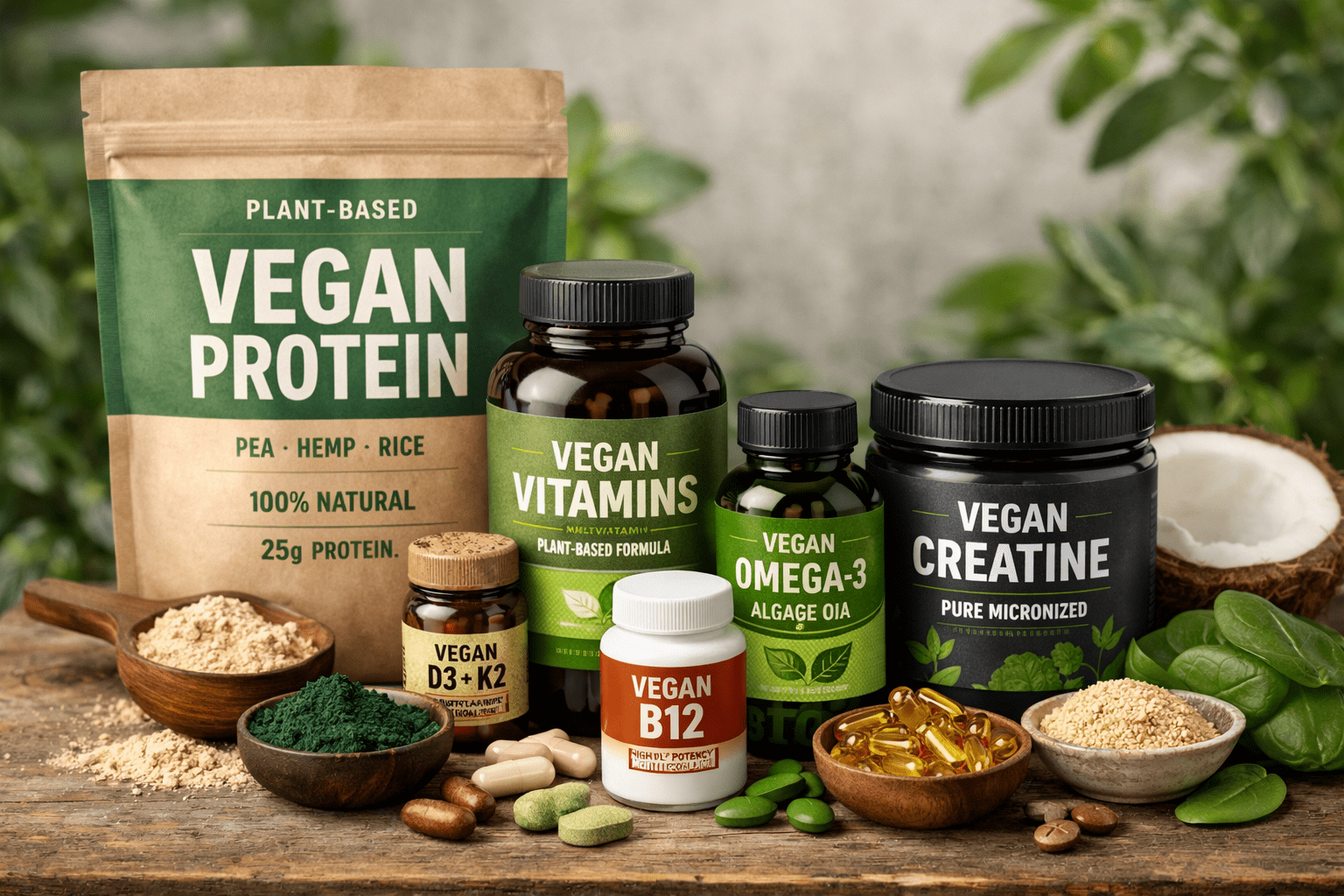
The key basics: B12, Vitamin D, Omega-3
1) Vitamin B12: For vegans, almost always essential
Vitamin B12 is the central “critical” nutrient in a vegan diet. The body cannot produce B12 on its own; reliable, meaningful amounts are generally not found in unprocessed plant foods. Therefore: if you eat vegan, you should supplement B12 or consistently use B12-fortified foods in sufficient amounts.
Important: “Fermented foods” (e.g., kombucha, sauerkraut) are not a reliable source of B12. Even if B12-like compounds may occur, the amount and bioavailability are usually not consistently predictable.
2) Vitamin D: Often useful — especially in winter
Vitamin D is produced through sunlight, but in many regions (and with lots of indoor time) seasonal sunlight is not sufficient. That’s why vitamin D is a common candidate for supplementation for many people — vegan or not.
For a vegan option: many vitamin D3 products are derived from lanolin (sheep’s wool). Vegan D3 typically comes from lichen. Alternatively, there is vitamin D2 (plant-based), which is also used.
3) Omega-3: ALA isn’t always enough — consider EPA/DHA
Omega-3 fatty acids are often associated with fish. In a vegan diet, the base omega-3 fatty acid ALA can be obtained well (e.g., flaxseed/flax oil, chia seeds, walnuts). However, the body converts ALA only to a limited extent into EPA and DHA.
If you want to be on the safe side, consider an algae oil supplement (EPA/DHA) — a direct vegan source of the omega-3 forms typically obtained from fish.
Other nutrients: iodine, iron, zinc, calcium & more
Beyond the “basics,” there are other nutrients that can become relevant depending on your diet. There is rarely a universal “must,” but often a “check and supplement if needed”.
Iodine
Iodine is important for the thyroid. In a vegan diet, iodine can be covered through iodized salt (and some fortified products). Seaweed/kelp can contain highly variable (sometimes extremely high) amounts — so caution is advised.
Iron
Plant-based iron (non-heme iron) is absorbed better when vitamin C is part of the same meal. If fatigue, reduced performance, or low ferritin levels are present, supplementation may be helpful — but not “blindly”, because too much iron can also be harmful.
Calcium & Zinc
Calcium: e.g., calcium-fortified plant milks, tofu (set with calcium), kale, broccoli, sesame/tahini. Zinc: e.g., legumes, whole grains, nuts/seeds. If your diet is very limited, supplementation may become relevant.
Practical tip: A “good” multivitamin can be convenient — but it isn’t automatically better. Often, a targeted setup (B12 + possibly D + possibly algae-based omega-3 + depending on need iodine/iron) is more useful than a confusing all-in-one mix.
What about vitamin B6, spirulina, milk thistle, turmeric, MSM & magnesium?
This deserves a clear classification: many of these products are used for “support,” but in most cases they are not vegan-specific essentials.
- Vitamin B6: Found in many plant foods (e.g., whole grains, legumes, nuts, potatoes, bananas). With a varied vegan diet, B6 supplementation is often unnecessary.
- Spirulina/Chlorella: Can contain interesting micronutrients, but are not a reliable strategy for “critical” nutrients. If used, look for quality and contaminant testing.
- Milk thistle: Traditionally used; evidence is mixed depending on the claim. Don’t treat it as a “detox must.”
- Turmeric: Popular in daily life; as a spice it can be useful. As a high-dose supplement, evidence is not universally strong and interactions are possible.
- MSM & magnesium: May be helpful for certain people (e.g., cramps/high load), but should ideally reflect need.
- Protein powder & creatine: More “performance supplements.” Helpful for training goals, but not required for a healthy vegan diet.
Overview table: nutrients, vegan sources & when supplements can be useful
| Nutrient | Vegan sources | Supplement useful when … |
|---|---|---|
| Vitamin B12 | Fortified foods (targeted), supplement | … you eat vegan (practically standard). Keep blood values in mind. |
| Vitamin D | Sunlight (seasonal), fortified foods, vegan D2/D3 | … little sun/often winter, or blood levels are low. |
| Omega-3 (EPA/DHA) | Algae oil (direct), ALA: flax/chia/walnuts (indirect) | … you want to ensure EPA/DHA (e.g., low ALA intake, special life stages). |
| Iodine | Iodized salt, some fortified foods | … you rarely use iodized salt or need to clarify thyroid issues. |
| Iron | Legumes, whole grains, pumpkin seeds, spinach; plus vitamin C | … ferritin/CBC is low or symptoms + medical recommendation. |
| Calcium | Fortified plant milks, tofu (with calcium), kale, sesame | … your diet is low in calcium or a clinician recommends it. |
| Zinc | Legumes, nuts/seeds, whole grains; soaking/sprouting helps | … very limited diet or lab values are low. |
| Selenium | Brazil nuts (watch portions), whole grains, legumes | … selenium-poor region/diet and values/recommendation support it. |
| Protein | Legumes, tofu/tempeh, seitan, soy yogurt, whole grains | … you have higher athletic targets or need convenience/time savings. |
| Creatine | — (typically not present in meaningful amounts in plants) | … you want to optimize performance in strength training (optional). |
What makes high-quality vegan supplements?
Good supplements are less about marketing promises and more about transparency, ingredient quality, and clear labeling. In particular, look for:
Quality indicators
- Clear dosage per serving (not just “proprietary blends”)
- Vegan label and source details (e.g., D3 from lichen)
- Lab testing/batch verification (especially for algae oil, minerals)
- Good bioavailability (appropriate forms, sensible formulation)
- Few unnecessary additives (colors, needless fillers)
Red flags
- Unrealistic health claims (“detox,” “cleanses in 7 days,” “cures”)
- No information on ingredient sourcing or dosage
- Extremely high doses without a clear rationale
- No independent testing for sensitive ingredients (e.g., algae products)
Rule of thumb: if a product “does everything,” it often fails at the most important thing — supplementing in a targeted and transparent way.
Beginner checklist: how to start sensibly
Basic setup (useful for many vegans)
- Vitamin B12 (standard)
- Vitamin D (often seasonal — ideally guided by blood tests)
- Omega-3 from algae oil (EPA/DHA, if you want to ensure coverage)
Depending on your situation, consider checking
- Iodine (do you consistently use iodized salt?)
- Iron (ferritin/CBC, menstrual cycle, endurance training)
- Calcium (very few fortified products/tofu/greens?)
- Zinc (very little legumes/whole grains/nuts?)
- Protein/Creatine (for athletic goals — optional)
Tip: Especially in the first 8–12 weeks after switching, a simple plan helps: basic setup + nutrient-dense foods + after some time, check blood values (depending on your situation, in consultation with your doctor).
FAQ
Are fortified foods enough instead of supplements?
Possible, but only if you reach reliable and sufficient amounts (e.g., for B12). Many still prefer a supplement because it’s easier to plan consistently.
Can I cover B12 through fermented foods?
In practice: usually no. Fermentation is not a reliable B12 strategy because amounts, stability, and bioavailability vary widely.
Do I need vitamin B6 as a vegan supplement?
Often not if your diet is varied (whole grains, legumes, nuts/seeds, fruits/vegetables). Targeted supplementation is more of an exception and should match actual need.
Can you take “too much” supplementation?
Yes. Especially with iron, iodine, fat-soluble vitamins, or very high-dose products, excessive intake can be harmful. That’s why: targeted rather than blind — and use lab values when unsure.
Conclusion
Do vegans need dietary supplements? It depends — but with one clear core point: Vitamin B12 is practically always necessary on a vegan diet.
Beyond that, vitamin D (often seasonally) and omega-3 (EPA/DHA from algae oil) are sensible additions for many vegans. Other nutrients such as iodine, iron, calcium, or zinc depend strongly on your diet, life stage, and blood values.
If you plan your diet well, review it regularly, and supplement selectively when needed, a vegan diet can be stable and healthy long term — without “supplement overload,” but also without unnecessary risks.