
Guide
Iron Bisglycinate Bioavailability: Why this form works and is gentle on the stomach
This article is about iron bisglycinate bioavailability—in other words, why chelated iron often “arrives” better for many people than classic iron salts. You’ll learn how iron bisglycinate works in the gut, why it’s often easier on the stomach, and what to look for with vegan iron bisglycinate.
Why iron supplements often cause issues
Fatigue, trouble concentrating, pale skin, feeling drained quickly—many people recognize this mix. Often, iron deficiency is the reason. The diagnosis is straightforward, and the solution seems obvious: take iron.
In real life, though, the plan often fails for one simple reason: tolerability. Classic iron tablets can cause nausea, abdominal pain, constipation, or diarrhea. That’s why some people stop their iron course early—even though levels typically need time to recover.
In short: the problem is often not “iron itself,” but the form it comes in—and how your gut handles it.
One form that has been recommended more and more in recent years is iron bisglycinate (often called “chelated iron”). The reason: it is considered well tolerated, and iron bisglycinate bioavailability is frequently described as particularly high.
What exactly is iron bisglycinate?
In many conventional products, iron is present as a salt—for example ferrous sulfate, ferrous fumarate, or ferrous gluconate. These forms are common, inexpensive, and generally effective—yet often “harsh” on the stomach.
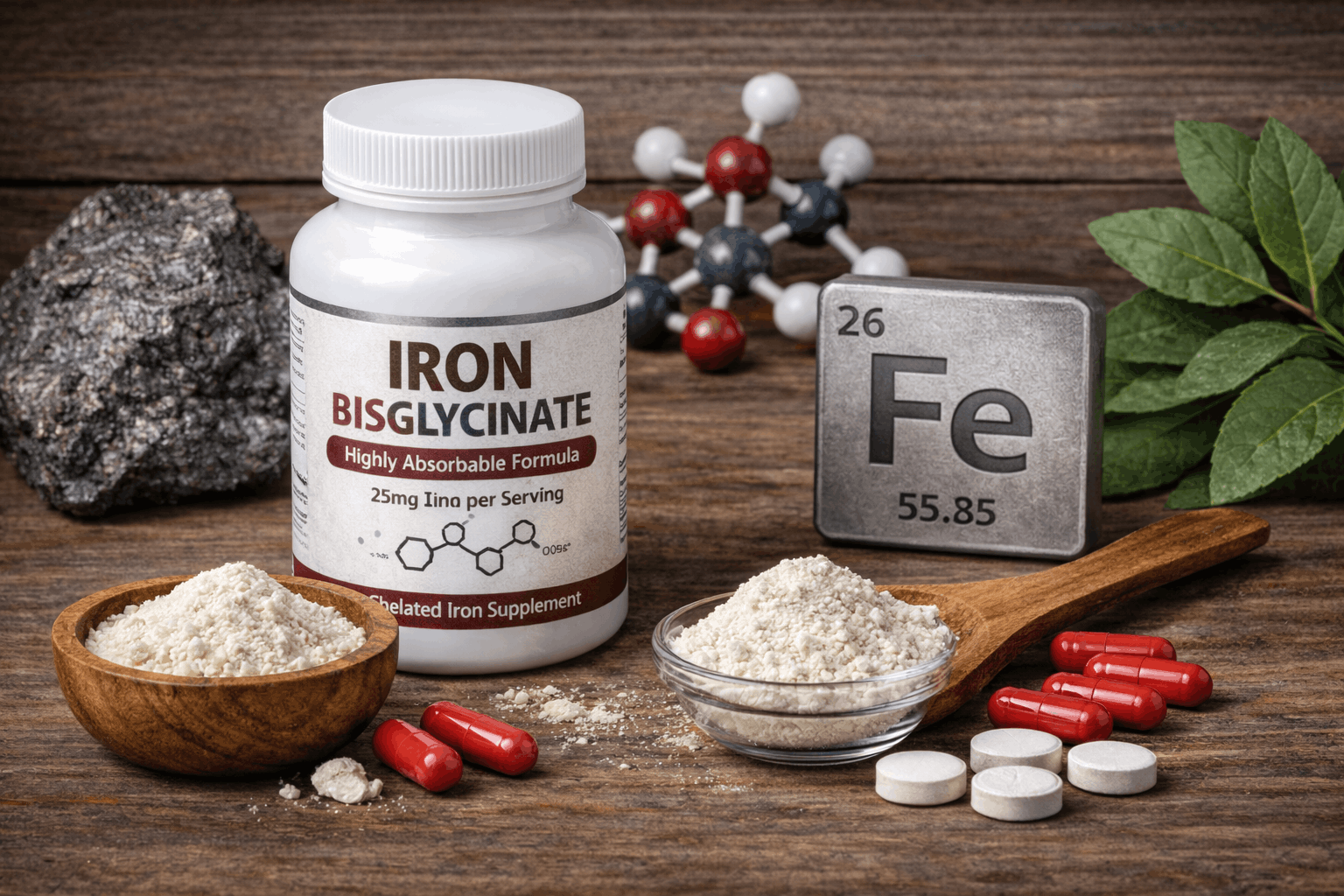
Iron bisglycinate works differently: the iron is bound to two molecules of the amino acid glycine. This is called a chelate (chele = “claw”), because the amino acids surround the iron. This binding is more than a technical detail—it changes how the digestive tract handles the iron.
Remember: iron bisglycinate isn’t “more iron”—it’s iron packaged differently. And that packaging often determines how well you tolerate it and how much actually gets absorbed.
Iron bisglycinate bioavailability: why this form may absorb better
In everyday terms, bioavailability means: How much of the iron you swallow actually gets into your body—rather than being excreted unused. This is where iron bisglycinate often has advantages.
1) Different “entry routes” in the gut
Classic iron salts are more likely to behave like “free” iron in the intestine and mainly use standard mineral transport mechanisms. With iron bisglycinate, it’s discussed that the chelate (at least in part) can be taken up via amino-acid or peptide transport pathways. That can make absorption more efficient—especially when other minerals compete at the same time.
Practical idea: less competition often means less “traffic” at the absorption site.
2) Better protection from dietary inhibitors
Coffee, black tea, whole grains, legumes—excellent foods, but they can bind iron and reduce absorption. In iron bisglycinate, iron is more tightly bound to glycine, so it is often less prone to being “captured” too early in the digestive tract.
Note: “less prone” doesn’t mean “immune”—smart spacing still helps.
3) More effect per mg—often with a moderate dose
A practical benefit of iron bisglycinate bioavailability is this: if more iron is absorbed, in some cases a moderate dose can achieve the same effect that might otherwise require much more “standard” iron. This also matters for tolerability, because less unabsorbed iron remains in the gut.
Important: don’t take high-dose iron “just in case.” If you have symptoms, have ferritin, hemoglobin, and—if needed—other markers checked by a medical professional.
Why iron bisglycinate is often gentler on the stomach
Bioavailability is only half the story. For many people, the real game-changer is less stomach and gut stress. And that’s fairly easy to understand.
What often happens with classic iron salts
Forms such as ferrous sulfate can dissolve relatively quickly in the stomach and release free iron ions. These can:
- directly irritate the stomach lining (nausea, pressure, cramps),
- and—if the iron is not absorbed—move on to the large intestine and disrupt digestion (constipation/diarrhea).
Why iron bisglycinate behaves differently
With iron bisglycinate, iron is “buffered” by the glycine binding. It is often released less aggressively in the digestive tract, which can feel more stomach-friendly. In addition, more efficient uptake in the small intestine often means less “leftover iron” remains in the gut—this leftover iron is frequently what triggers digestive side effects.
Remember: the better your body absorbs the iron, the less is left behind to irritate the gut—this is a key reason why many people tolerate iron bisglycinate better.
Vegan iron bisglycinate: is it useful on a plant-based diet?
If you eat a plant-based diet, iron can be especially relevant—not because vegan diets are “bad,” but because non-heme iron is generally more sensitive to inhibitors. Phytates from whole grains and legumes, or polyphenols from tea/coffee, can reduce absorption.
This is where vegan iron bisglycinate is often mentioned as a practical option: thanks to the chelate structure, absorption can be more stable in everyday life, especially when meals include typical plant-based “blockers.”
How to recognize “vegan iron bisglycinate”
- The iron form: Look for “iron bisglycinate,” “ferrous bisglycinate,” or “iron(II) bisglycinate.”
- The capsule: Vegan capsules are usually HPMC/cellulose—not gelatin.
- Add-ons: Some products combine iron with vitamin C (often practical), others include many unnecessary additives (not required).
Note: “vegan” doesn’t automatically mean “better dosed.” What matters is whether the dose fits your needs—and whether you know your lab values.
How to take it: timing, combinations & common mistakes
Even the best iron form won’t help much if everyday timing constantly blocks absorption. With a few simple rules, you can get much more out of it—without making things complicated.
Everyday timing
- Between meals iron is often absorbed best (e.g., 30–60 minutes before eating or 2 hours after).
- If you feel nauseous: take it with a small, light snack (e.g., fruit)—better consistent than “perfect but rare.”
- Evenings often work well because coffee/tea and large meals can be harder to avoid during the day.
What can support absorption
- Vitamin C may support non-heme iron uptake (e.g., water with lemon or fruit).
- Keep distance from “blockers”: coffee, black/green tea, cocoa, very phytate-rich meals.
- Separate calcium: dairy or calcium supplements are often best taken at a different time.
Important: medications & iron
Iron can interact with certain medications—especially when taken at the same time. If you take medication (e.g., thyroid hormones, certain antibiotics, or acid blockers), plan iron with spacing and clarify details with a doctor or pharmacist if needed.
Dosage: less guessing, more structure
With iron, it’s genuinely worth not supplementing blindly. A blood test (ferritin, hemoglobin, and sometimes transferrin saturation) shows whether you have an issue—and how large it is. Then you can decide whether a low dose is enough or whether therapeutic doses should be medically guided.
Everyday tip: Look for the amount of elemental iron on the label. It’s not only the iron compound that matters, but how much elemental iron you actually get per serving.
Overview table: ferrous sulfate vs. iron bisglycinate
| Feature | Ferrous sulfate (classic) | Iron bisglycinate (chelated) |
|---|---|---|
| Bioavailability | Moderate (more dependent on timing & diet) | Often higher and more stable in everyday use |
| Interactions with coffee/tea/phytates | Strong | Often lower (spacing still helpful) |
| Nausea & stomach pain | Relatively common | Many report fewer issues |
| Constipation / digestive issues | Common | Often less common |
| Price | Very inexpensive | Somewhat more expensive |
| Best for | Robust stomach, strict timing doable | Sensitive stomach, everyday practicality, vegan diet |
Who benefits most from switching?
Because of the combination of iron bisglycinate bioavailability and often good tolerability, this form can be especially useful for:
- People with a sensitive stomach (nausea, heartburn, “iron upsets my stomach”).
- Anyone who can’t stick with classic iron products because of side effects.
- Vegans & vegetarians who want an efficient option (vegan iron bisglycinate).
- Athletes—if values are checked and stores need to be replenished without stressing digestion.
- Pregnant people (only with medical guidance), if need and lab values are clearly assessed.
Safety note: iron is not a “lifestyle supplement.” In certain conditions (e.g., iron overload/hemochromatosis), extra iron can be harmful. Get values checked and avoid long-term high dosing without medical supervision.
FAQ
Do I need to take iron bisglycinate on an empty stomach?
Taking it on an empty stomach is often “optimal” for absorption. But if you tend to feel nauseous, it can be better to take it with a small snack so you can stay consistent. Iron bisglycinate is often better tolerated than classic salts—routine still matters most.
Can I take iron bisglycinate with coffee or tea?
Coffee and tea can reduce iron absorption. Iron bisglycinate is often less sensitive, but spacing (e.g., 1–2 hours) remains a solid practical rule— especially if your levels drop easily.
How can I identify “vegan iron bisglycinate”?
Look for the iron form (iron bisglycinate/ferrous bisglycinate) and the capsule shell (HPMC/cellulose rather than gelatin). Also check additives and the amount of “elemental iron” per serving.
How fast will my ferritin improve?
It varies a lot and depends on how low you are, how consistently you take it, and whether there’s an underlying cause (e.g., blood loss, heavy periods, absorption issues). This is usually a weeks-to-months process. Follow-up labs should be planned with a clinician.
Can you take too much iron?
Yes. Iron should not be high-dosed long term without a confirmed need. If you suspect deficiency, lab work (ferritin, Hb, etc.) is the best starting point. If stores are already high or iron overload is present, extra iron may be harmful.
Conclusion
If you’ve struggled with iron supplements in the past, the issue is often not you—it’s the form that your digestive system doesn’t tolerate well. That’s why iron bisglycinate is a top alternative for many people: iron bisglycinate bioavailability is often high, and at the same time it’s frequently perceived as noticeably gentler on the stomach.
Especially for sensitive digestion and for plant-based diets (vegan iron bisglycinate), investing in a quality chelated iron can be worth it—provided you approach it systematically, know your lab values, and build a routine you can actually stick to.